

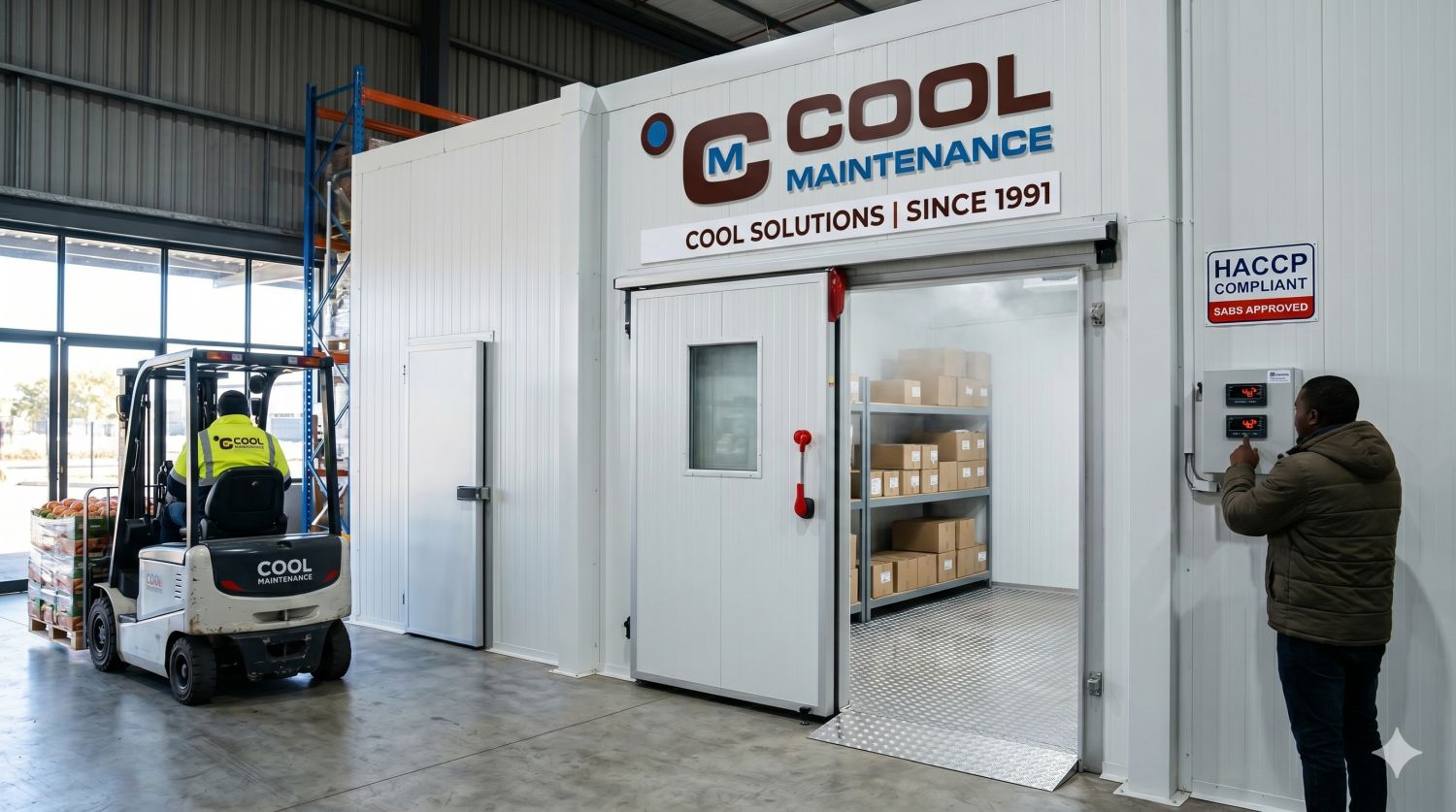
Whether you run a busy restaurant, a pharmaceutical warehouse, or a fruit-packing facility in the Lowveld, choosing the right cold room is one of the most important decisions your business will make. A poorly matched cold room costs you money in energy bills, product losses, and repairs.
At Cool Maintenance, we have been building and supplying cold and freezer rooms across South Africa for over 33 years. We know that the ideal solution in Johannesburg where summer temperatures regularly push past 35°C may differ from what works best in Cape Town or in a cooler coastal town.
Here is what to consider when choosing the right cold room for your business.
Understand What You Need to Store
The first and most fundamental question is: what will go inside the cold room?
Different products require different temperature ranges, and those ranges have a direct impact on the type of room you need.
As a general guide:
- Fresh produce and dairy: typically 2°C to 8°C
- Meat and fish: 0°C to 4°C
- Frozen goods: -18°C to -25°C
- Pharmaceuticals: often 2°C to 8°C with tight tolerances
- Wine cellars: 10°C to 16°C, humidity-controlled
A walk-in chiller will not suffice if you are storing frozen poultry. Equally, investing in a deep-freeze room for products that only need to be chilled is an unnecessary cost.
Getting clarity on your temperature requirements from the outset is essential.
Consider Your Industry’s Compliance Requirements
Temperature alone is not the only factor. Depending on your industry, you may need to meet the standards of the Hazard Analyses Critical Control Point (HACCP) system, the South African Bureau of Standards (SABS), or other regulatory bodies.
Cool Maintenance manufactures cold rooms using tongue-and-groove, pre-painted galvanised steel panels with no exposed joints. These panels are designed to be easy to clean and corrosion-resistant, making them suitable for environments where hygiene is non-negotiable.
All our rooms comply with HACCP standards, and our insulated panels also meet SABS and EU regulations.
Think About Your Location and Climate
South Africa’s climates vary significantly from region to region, and this affects how hard your refrigeration system has to work, and therefore which insulation and panel specifications are appropriate for your cold room.
In Johannesburg and Pretoria, the Highveld’s high summer temperatures and low humidity create a specific set of demands. The heat load is intense during the day, which means your cold room panels need to offer excellent thermal resistance to prevent your system from working overtime.
Thicker panels with high R-values are often a smart investment here.
On the coast, whether in Cape Town, Durban, or Port Elizabeth, humidity is a bigger concern alongside heat. Moisture infiltration is one of the most common causes of cold room performance problems. Our panels are sealed against moisture intrusion, helping protect the insulation core and the refrigeration system.
We address this in more detail in our post on common cold storage mistakes and how to fix them.
In inland areas with extreme temperature swings, such as the Northern Cape or parts of Limpopo, thermal bridging becomes a significant risk. Our continuous insulation panels eliminate the cold spots that conventional insulation can leave behind, as explained in our guide to how insulated structures help improve cold room performance.
Choose the Right Panel Type
The insulated panel is the backbone of any cold room. Choosing the wrong panel type is one of the costliest mistakes a business can make. Cool Maintenance offers three primary options, each suited to different applications:
- Polystyrene (EPS) panels: Cost-effective and widely used for standard cold and chiller rooms. EPS offers good thermal resistance for most commercial applications.
- Polyurethane (PU) panels: A step up in thermal performance, PU panels offer a higher R-value per centimetre of thickness. They are particularly suited to freezer rooms and environments where space efficiency matters.
- Rockwool panels: The go-to option where fire resistance is a priority. Rockwool is non-combustible and offers both thermal and acoustic insulation.
Understanding the difference between insulated panels and traditional insulation can help clarify why modern sandwich panels outperform older methods in almost every cold room application.
Size, Layout, and Access Points
Bigger is not always better. A cold room that is too large for your throughput will cycle product slowly, create uneven temperatures, and use more energy than needed. Too small, and you will be turning away stock or running product at unsafe temperatures during peak periods.
Think about your peak storage volume, not just your average, and plan accordingly. Also consider traffic flow. High-traffic cold rooms benefit from sliding doors that allow forklifts or pallet jacks to move freely. Lower-traffic environments may work perfectly well with hinged doors. Both can be fitted with PVC strip curtains to reduce temperature fluctuation during entry and exit.
Flooring is another consideration that is easy to overlook.
Our reinforced aluminium checker plate flooring suits most standard cold room applications, while high-traffic environments such as abattoirs and distribution centres often require heavy-duty in situ concrete floors with a multi-layered insulation system beneath.
Work with a Manufacturer That Deploys Nationwide
Cool Maintenance operates state-of-the-art manufacturing plants in both Cape Town and Port Elizabeth, with the ability to deploy and install cold rooms across South Africa.
Whether your facility is in the Gauteng industrial corridor, KwaZulu-Natal’s agricultural heartland, or a remote processing site in the Free State, we can deliver and install a solution tailored to your environment. You can explore our recent projects to see the range of environments and industries we have worked in.
Get in touch with our team at Cool Maintenance for expert guidance and a cold room solution designed around your specific needs. CONTACT US today.